

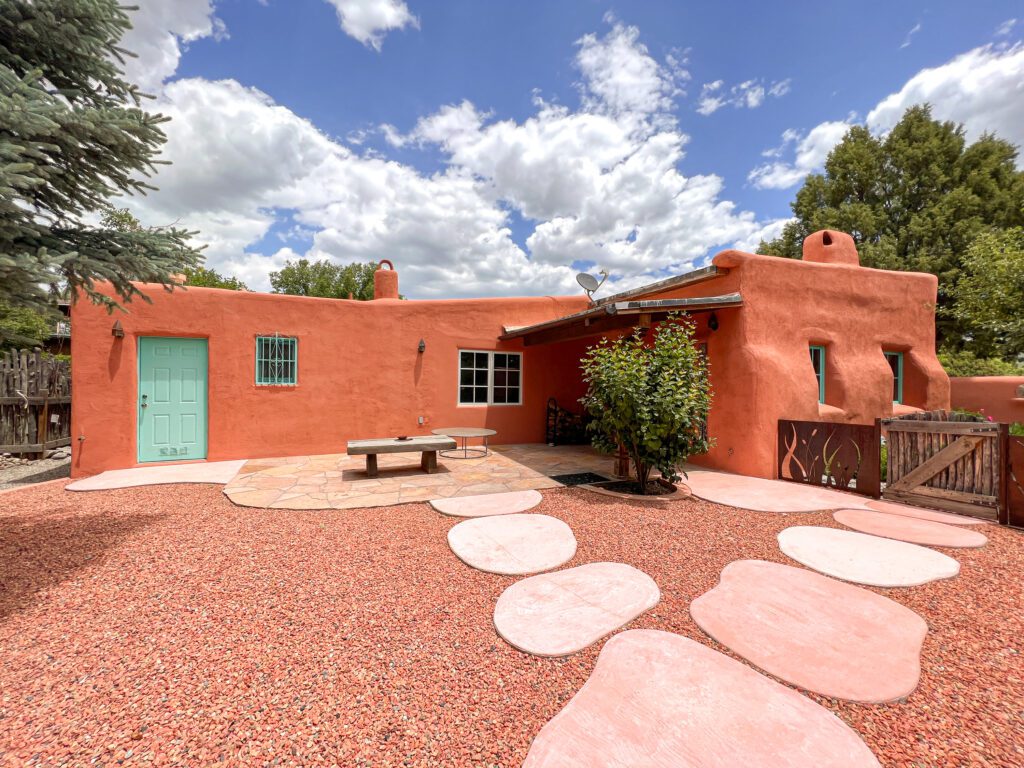
Adobe Construction Cost in New Mexico: What Actually Drives the Price
A contractor quoting $180 a square foot for an adobe home and another quoting $340 for what sounds like the same project can both be pricing it honestly. The gap usually is not padding on one end or a lowball on the other. It comes from real differences in wall thickness, where the brick is sourced, and sometimes from whether the walls are earthen at all, since a good share of what gets sold as “adobe” in New Mexico new construction is stucco over a wood frame, styled to look the part. Our own breakdown of what it costs to build a house in Albuquerque puts finished conventional construction between roughly $175 and $310 per square foot depending on build type and finish level. True adobe, the kind where the block itself carries the structural load rather than framing behind a finish coat, typically runs 15 to 25 percent above that. Applied to the same range, that puts full adobe construction closer to $200 to $390 per square foot for the shell, before land, design fees, engineering, and site work are added in. That range still is not the full picture, because adobe is not one method. It is several, and each prices differently. Traditional Adobe and Modern Adobe Price Differently A lot of what gets marketed as “adobe” in New Mexico new construction is actually stucco applied over wood or steel framing, styled to look like adobe without the earthen wall behind it. That approach costs closer to conventional stucco-clad framing, because structurally it is conventional framing. True adobe construction is a different category. Within it, the block itself varies. Traditional adobe brick is sun-dried earth, sand, and straw with no added stabilizer, typically produced on or near the site. Semi-stabilized brick adds a small amount of asphalt emulsion or cement to improve moisture resistance. Fully stabilized or pressed adobe block uses mechanical compression and a stabilizing agent, which increases strength and lets crews work through more of the year, but it also raises the material cost per unit. Sourcing matters as much as the block type. Bricks made on site from suitable local soil are usually the cheapest option, since you are paying for labor and molds rather than transport. Bricks purchased from a commercial adobe yard cost more per unit but arrive with more consistent dimensions and documented compressive strength, which matters for permitting. Either way, material cost is rarely what drives an adobe budget. Labor is. What Actually Makes New Adobe Construction Expensive The wall is the biggest cost driver, and it drives several other costs with it. Adobe walls are typically 10 to 14 inches thick to meet New Mexico’s structural provisions for unburned clay masonry, compared with roughly 6 inches for a framed wall with siding. That extra mass means a heavier foundation is required to carry the load, more material and labor to raise the wall itself, and a longer timeline since courses need to cure between lifts. Skilled labor is the second constraint, and it is a real one. Framing crews are common across New Mexico. Crews with genuine adobe experience, meaning they understand coursing, bond beams, and how to tie a roof system into an earthen wall correctly, are a much smaller pool, concentrated around Santa Fe, Taos, and parts of the Albuquerque metro. That scarcity shows up directly in labor rates and in how far in advance you need to book a qualified crew. Roofing and drainage detailing add cost that a conventional home does not carry in the same way. Water is adobe’s primary threat, so flat parapet roofs with canales, proper roof drainage away from the wall base, and foundation moisture protection are not optional extras. They are what keeps the wall system performing for decades instead of degrading in a few wet seasons, and skipping or underbuilding them is the single most common way an adobe project gets expensive later instead of now. Engineering and design documentation cost more too. New Mexico’s building code requires construction documents from a registered design professional for most structural work, and adobe carries its own set of structural provisions beyond the standard residential code, which means the architect or engineer on an adobe project needs specific familiarity with earthen construction, not just general residential design experience. Adobe Additions Carry Their Own Cost Logic Adding onto an existing adobe home is not simply new construction at a smaller scale. The new wall has to tie into an existing foundation that was designed decades, sometimes a century, before current code. Matching wall thickness, plaster texture, and finish color against a wall that has weathered for years is a skilled, time-consuming task, and a visible mismatch is often more costly to fix after the fact than to get right the first time. Location within New Mexico affects addition pricing more than it does for a standard framed addition. Santa Fe and Taos tend to sit at the top of the state’s addition cost range, partly because of the same adobe-specific labor scarcity described above, and partly because historic district design review in those markets adds time and documentation that flows directly into project cost. Albuquerque and Las Cruces generally sit in the middle of the range, with more contractor competition and less blanket historic review. Rural areas can price lower, but material and skilled-labor transport can offset some of that savings depending on the site. If your addition also touches an existing room, our home addition team handles the structural tie-in and permitting alongside the adobe-specific work, rather than treating them as two separate contracts. Restoration and Repair Have the Widest Range of Any Adobe Project New construction and additions at least follow a predictable cost logic once you know the scope. Restoration does not, because the starting condition of the wall varies enormously from one property to the next. On the low end, routine adobe maintenance, meaning re-plastering or re-mudding a wall that is otherwise structurally sound, is a relatively contained expense