

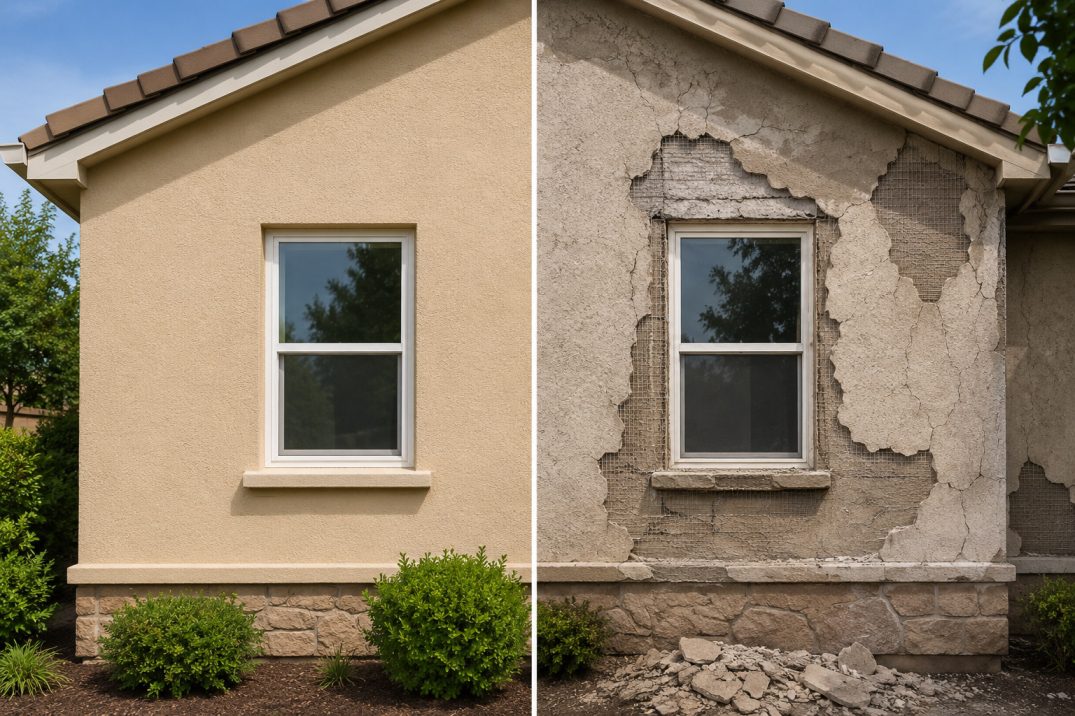
Stucco Resurfacing vs. Full Replacement: Which Does Your New Mexico Home Need?
Stucco begins to show its age in ways that look worse than they are. Faded color, a network of hairline cracks, a patchy section near a roofline: property owners who contact a stucco contractor often believe they are facing a full replacement. More often than not, they are not. But the opposite mistake happens too. A contractor who slaps an elastomeric coat over a moisture-compromised wall has created a moisture trap, not a repair. That is the scenario that turns a $4,000 resurfacing job into a $22,000 substrate rebuild two years later. The right call depends on what is happening beneath the finish coat. Understanding the difference between stucco resurfacing and full stucco replacement. How New Mexico’s climate accelerates certain types of failure is the framework every homeowner needs before spending a dollar. Quick answer: If your stucco substrate is structurally sound and dry, resurfacing is likely the correct scope. If there is moisture infiltration, delaminated base coats, or failed lath, full replacement is the appropriate path. What Stucco Resurfacing Actually Is Stucco resurfacing means applying a new finish coat (and in some cases a thin color coat or textured acrylic layer) over an existing stucco system that is still performing structurally. The base coat (scratch coat and brown coat in a traditional three-coat system) remains in place. Only the outer layer is refreshed. Resurfacing can accomplish several things at once: It is not a repair for structural problems. Resurfacing works on walls that have reached end-of-finish-coat life but still have a sound, dry base underneath. For homeowners across New Mexico, a quality resurfacing job can extend the service life of exterior stucco by 10 to 20 years when properly applied over a sound substrate. See our stucco services for a closer look at the system types we work with across the state. What Full Stucco Replacement Involves Full replacement means removing the existing stucco system entirely, back to the lath, wire mesh, or sheathing, and rebuilding the wall system from the substrate out. In a traditional three-coat cement stucco application, this means a new scratch coat, brown coat, and finish coat. In an EIFS (synthetic foam-core) system, it means removing the foam board, resetting trim, and reinstalling the full system. Full replacement is warranted when: This is a significantly more disruptive and expensive scope of work. It also uncovers any underlying issues with flashing, waterproofing membranes, and window integration that a resurfacing job would simply cover up. That trade-off is simultaneously its greater cost and its greater long-term value. Stucco Resurfacing Cost vs. Replacement Cost in New Mexico Pricing in New Mexico varies by region, system type, substrate condition, and the specific scope of prep work required. These ranges reflect real project conditions across the state in 2026: Scope Description Cost per Sq Ft (NM) Typical Total Range Color Coat Only Elastomeric or acrylic finish coat over sound existing stucco $3.00 – $5.00 $4,500 – $10,000 Full Resurfacing Surface prep, crack repair, full finish coat reapplication $5.00 – $7.50 $7,500 – $18,000 Partial Replacement Remove and replace damaged sections, blend into existing $8.00 – $13.00 $5,000 – $20,000+ Full 3-Coat Replacement Complete removal down to lath, full rebuild $10.00 – $18.00 $18,000 – $45,000+ EIFS Full Replacement Foam board, base coat, mesh, finish: full reinstallation $12.00 – $22.00 $22,000 – $55,000+ Price drivers in New Mexico include access difficulty (single-story vs. multi-level), the age and type of the existing system, whether window and door flashing needs to be reset during the work, and, critically, moisture conditions in the wall. A home in Las Cruces with UV-driven surface delamination on sound dry walls prices very differently than a Santa Fe property where freeze-thaw has damaged the brown coat layer. For an accurate number on your specific property, our team provides free on-site estimates. Contact us through our roofing and exterior services page or the stucco services contact form. How New Mexico’s Climate Shapes the Decision No other factor influences a stucco damage assessment more than where in New Mexico a home is located. The state’s climate variation between its lowest and highest elevations (from Las Cruces in the Chihuahuan Desert to Taos at over 6,900 feet) creates fundamentally different stucco failure patterns. Albuquerque: Thermal Cycling and Monsoon Infiltration Albuquerque’s stucco problem is a two-part cycle. Intense daytime heat expands the wall system; cool overnight temperatures contract it. This thermal cycling opens hairline cracks throughout the dry season. When monsoon arrives in July and August, those cracks act as channels, pushing moisture into the base coat layer before the visible exterior damage signals anything serious. By the time a homeowner notices staining or efflorescence, the moisture has often been in the wall through at least one full cycle. Resurfacing is appropriate for Albuquerque homes with surface cracks that have not yet allowed moisture infiltration. Typically, cracks narrower than 1/16 inch that can be tapped and sound solid. Anything that resonates hollow warrants deeper investigation before resurfacing is considered. Santa Fe and Taos: Freeze-Thaw Damage At higher elevations, stucco failure is more often a freeze-thaw problem than a UV or thermal-cycling issue. Water enters small cracks or permeable areas, freezes, expands, and mechanically fractures the surrounding material. This type of damage progresses faster than UV delamination and tends to affect the base coat more aggressively. Homes in Santa Fe and Taos with flaking stucco, visible vertical fractures along lath seams, or sections that sound hollow are candidates for partial or full replacement more often than ABQ homes with similar surface appearance. Resurfacing over freeze-thaw-damaged base coats delays a larger failure rather than resolving it. Las Cruces and Southern New Mexico: UV Delamination Extreme UV exposure in the southern part of the state causes the finish coat to chalks, loses adhesion, and separates from the base coat rather than cracking. This delamination pattern can look alarming but often indicates a finish layer that has exceeded its service life rather than a compromised substrate. Provided the brown coat beneath is solid (a tap