Stucco begins to show its age in ways that look worse than they are. Faded color, a network of hairline cracks, a patchy section near a roofline: property owners who contact a stucco contractor often believe they are facing a full replacement. More often than not, they are not.
But the opposite mistake happens too. A contractor who slaps an elastomeric coat over a moisture-compromised wall has created a moisture trap, not a repair. That is the scenario that turns a $4,000 resurfacing job into a $22,000 substrate rebuild two years later.
The right call depends on what is happening beneath the finish coat. Understanding the difference between stucco resurfacing and full stucco replacement. How New Mexico’s climate accelerates certain types of failure is the framework every homeowner needs before spending a dollar.
Quick answer: If your stucco substrate is structurally sound and dry, resurfacing is likely the correct scope. If there is moisture infiltration, delaminated base coats, or failed lath, full replacement is the appropriate path.
What Stucco Resurfacing Actually Is
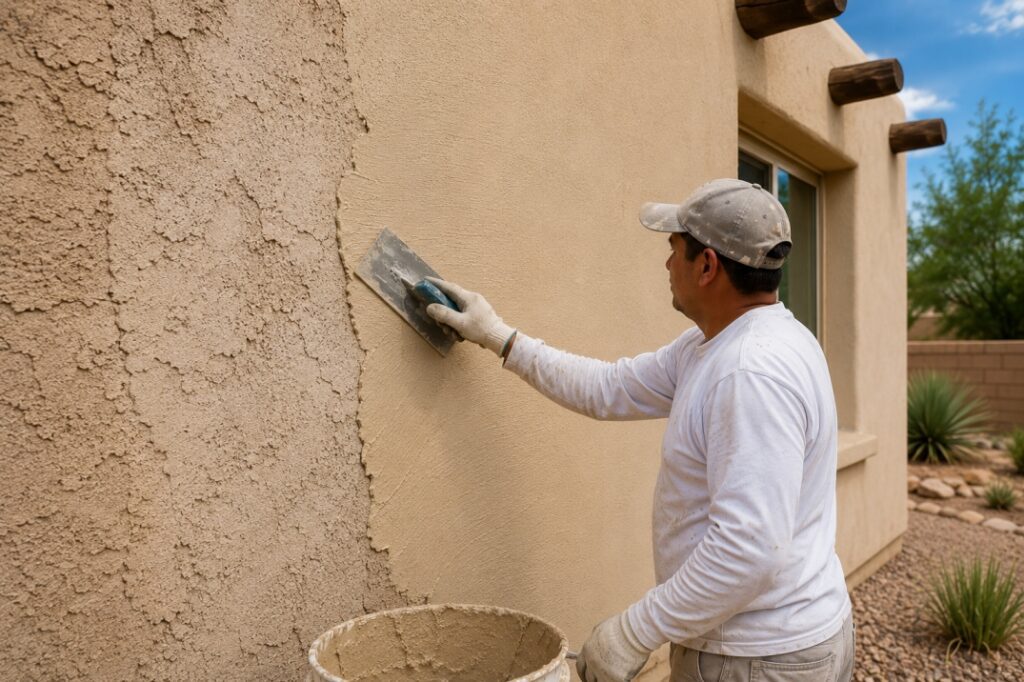
Stucco resurfacing means applying a new finish coat (and in some cases a thin color coat or textured acrylic layer) over an existing stucco system that is still performing structurally. The base coat (scratch coat and brown coat in a traditional three-coat system) remains in place. Only the outer layer is refreshed.
Resurfacing can accomplish several things at once:
- Restore faded or chalky color without repainting
- Correct minor texture inconsistencies from previous patch repairs
- Seal hairline surface cracks before moisture finds them
- Update the exterior appearance of a home without full renovation cost
- Apply a new acrylic or elastomeric finish with improved UV resistance
It is not a repair for structural problems. Resurfacing works on walls that have reached end-of-finish-coat life but still have a sound, dry base underneath.
For homeowners across New Mexico, a quality resurfacing job can extend the service life of exterior stucco by 10 to 20 years when properly applied over a sound substrate. See our stucco services for a closer look at the system types we work with across the state.
What Full Stucco Replacement Involves
Full replacement means removing the existing stucco system entirely, back to the lath, wire mesh, or sheathing, and rebuilding the wall system from the substrate out. In a traditional three-coat cement stucco application, this means a new scratch coat, brown coat, and finish coat. In an EIFS (synthetic foam-core) system, it means removing the foam board, resetting trim, and reinstalling the full system.
Full replacement is warranted when:
- The base coat has delaminated from the substrate in large sections
- Moisture has penetrated past the finish coat and saturated the brown coat or paper barrier
- The metal lath or wire mesh has corroded
- Stucco is pulling away from the wall in sheets rather than cracking in place
- A probe test reveals soft, crumbling material behind the finish coat
- Mold or organic growth is present within the wall assembly
This is a significantly more disruptive and expensive scope of work. It also uncovers any underlying issues with flashing, waterproofing membranes, and window integration that a resurfacing job would simply cover up. That trade-off is simultaneously its greater cost and its greater long-term value.
Stucco Resurfacing Cost vs. Replacement Cost in New Mexico
Pricing in New Mexico varies by region, system type, substrate condition, and the specific scope of prep work required. These ranges reflect real project conditions across the state in 2026:
| Scope | Description | Cost per Sq Ft (NM) | Typical Total Range |
| Color Coat Only | Elastomeric or acrylic finish coat over sound existing stucco | $3.00 – $5.00 | $4,500 – $10,000 |
| Full Resurfacing | Surface prep, crack repair, full finish coat reapplication | $5.00 – $7.50 | $7,500 – $18,000 |
| Partial Replacement | Remove and replace damaged sections, blend into existing | $8.00 – $13.00 | $5,000 – $20,000+ |
| Full 3-Coat Replacement | Complete removal down to lath, full rebuild | $10.00 – $18.00 | $18,000 – $45,000+ |
| EIFS Full Replacement | Foam board, base coat, mesh, finish: full reinstallation | $12.00 – $22.00 | $22,000 – $55,000+ |
Price drivers in New Mexico include access difficulty (single-story vs. multi-level), the age and type of the existing system, whether window and door flashing needs to be reset during the work, and, critically, moisture conditions in the wall. A home in Las Cruces with UV-driven surface delamination on sound dry walls prices very differently than a Santa Fe property where freeze-thaw has damaged the brown coat layer.
For an accurate number on your specific property, our team provides free on-site estimates. Contact us through our roofing and exterior services page or the stucco services contact form.
How New Mexico’s Climate Shapes the Decision
No other factor influences a stucco damage assessment more than where in New Mexico a home is located. The state’s climate variation between its lowest and highest elevations (from Las Cruces in the Chihuahuan Desert to Taos at over 6,900 feet) creates fundamentally different stucco failure patterns.
Albuquerque: Thermal Cycling and Monsoon Infiltration
Albuquerque’s stucco problem is a two-part cycle. Intense daytime heat expands the wall system; cool overnight temperatures contract it. This thermal cycling opens hairline cracks throughout the dry season. When monsoon arrives in July and August, those cracks act as channels, pushing moisture into the base coat layer before the visible exterior damage signals anything serious. By the time a homeowner notices staining or efflorescence, the moisture has often been in the wall through at least one full cycle.
Resurfacing is appropriate for Albuquerque homes with surface cracks that have not yet allowed moisture infiltration. Typically, cracks narrower than 1/16 inch that can be tapped and sound solid. Anything that resonates hollow warrants deeper investigation before resurfacing is considered.
Santa Fe and Taos: Freeze-Thaw Damage
At higher elevations, stucco failure is more often a freeze-thaw problem than a UV or thermal-cycling issue. Water enters small cracks or permeable areas, freezes, expands, and mechanically fractures the surrounding material. This type of damage progresses faster than UV delamination and tends to affect the base coat more aggressively.
Homes in Santa Fe and Taos with flaking stucco, visible vertical fractures along lath seams, or sections that sound hollow are candidates for partial or full replacement more often than ABQ homes with similar surface appearance. Resurfacing over freeze-thaw-damaged base coats delays a larger failure rather than resolving it.
Las Cruces and Southern New Mexico: UV Delamination
Extreme UV exposure in the southern part of the state causes the finish coat to chalks, loses adhesion, and separates from the base coat rather than cracking. This delamination pattern can look alarming but often indicates a finish layer that has exceeded its service life rather than a compromised substrate. Provided the brown coat beneath is solid (a tap test and probe assessment will confirm this), resurfacing or an elastomeric overcoat is frequently the right scope. Our stucco repair services Las Cruces address the UV delamination patterns specific to that market.
Rio Rancho: Aging EIFS Systems
Many Rio Rancho homes built between 1985 and 2005 have EIFS (Exterior Insulation and Finish Systems), a synthetic foam-core stucco often confused with traditional hard coat. EIFS systems that were improperly flashed at windows and penetrations have a well-documented moisture infiltration history. Resurfacing an EIFS system that has moisture in the foam core creates a sealed moisture trap. These situations typically require full system removal, moisture remediation, and full EIFS or hard coat replacement.
The Assessment Every Contractor Should Do Before Recommending Either Option
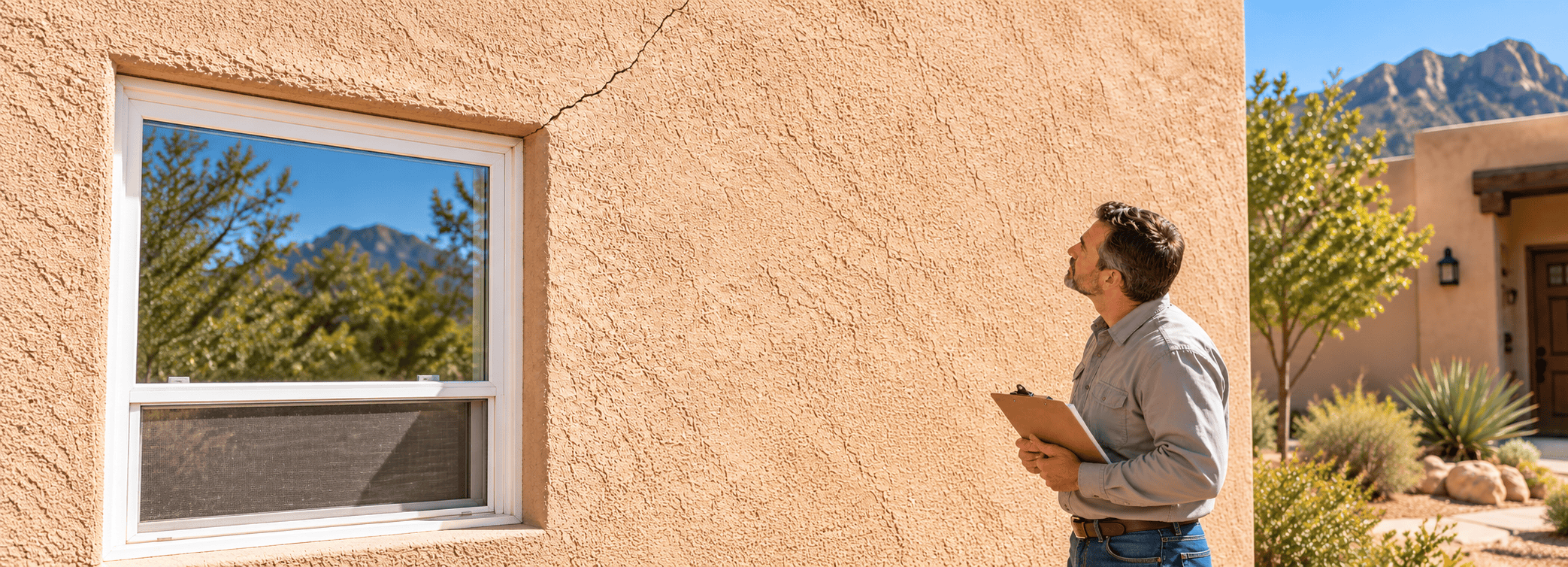
A responsible stucco contractor does not recommend resurfacing or replacement from the street. The assessment has specific steps, and skipping them leads to the wrong scope, in both directions.
- Visual inspection at multiple distances: street, arm’s length, and raking light to reveal texture inconsistencies and crack patterns
- Tap testing: methodically tapping sections of the wall and listening for hollow resonance that indicates delamination from the substrate
- Probe testing at suspicious areas: carefully probing soft or hollow spots to assess base coat integrity
- Moisture meter readings: surface readings and, where access allows, readings through penetrations or compromised sections
- Window and door flashing inspection: a significant proportion of New Mexico stucco moisture problems originate at window integration points, not at surface cracks
- Roofline and parapet inspection: stucco failure at parapet walls and roof-to-wall junctions is common on flat-roofed homes throughout Albuquerque and the surrounding area
Any contractor who looks at the exterior, announces a number, and reaches for a contract has skipped the diagnostic step. A thorough inspection takes 30 to 90 minutes depending on home size and damage extent. Do not accept a quote without it.
Elastomeric Coatings: Where They Help and Where They Cause Problems
Elastomeric coatings have become popular in New Mexico because they bridge hairline cracks, reduce UV degradation, and can extend stucco life meaningfully. They are a legitimate option in the right circumstances. They are also one of the most misapplied products in residential exterior work.
Where Elastomeric Coatings Work Well
- Homes with recurring hairline thermal cracks but dry, sound base coats
- Properties where repainting every 5 to 7 years is creating ongoing expense
- Desert climates like Albuquerque and Las Cruces where UV is the primary aging factor
- Homes where slight color variation from patched areas is visible. Elastomeric coats unify the surface
Where Elastomeric Coatings Create Problems
- Applied over moisture-compromised walls; the coating traps moisture in the wall system, accelerating base coat and lath degradation
- Applied over EIFS with moisture infiltration; this seals the problem in completely
- Applied without proper crack preparation; wide cracks require flexible backer rod and caulk before coating, not just a thick paint layer
- Applied to surfaces with active efflorescence; mineral salts continue to push from within and will cause the coating to bubble and peel
The Building Science Corporation has published extensive research on moisture management in wall assemblies that reinforces a fundamental principle: surface coatings that reduce vapor transmission should never be applied to wall systems with existing moisture problems. That principle applies directly to elastomeric stucco coatings on New Mexico homes with monsoon-season infiltration history.
The Resale and Insurance Angle
Homeowners preparing to sell a property in New Mexico should understand how stucco condition affects both transaction timing and buyer inspection outcomes. Stucco that has visible cracking or moisture staining is routinely flagged in home inspections, and in a market where buyers have options, it can become a negotiating point even when the underlying condition is manageable.
A professional resurfacing job on a home with sound stucco structure does two things simultaneously: it resolves an inspection concern and improves curb appeal at a fraction of the cost of replacement. That math is often compelling in the months before a listing.
On the insurance side, some homeowner policies in New Mexico include exclusions or riders related to exterior stucco condition. The specifics vary by policy and carrier, but homes with documented moisture damage at stucco penetrations are occasionally flagged during policy renewals. Proper repairs and documented contractor work provide a paper trail that supports coverage conversations.
When Resurfacing is the Right Answer
- The tap test reveals a solid, consistent base coat with no hollow sections
- A moisture meter shows dry readings throughout the wall, particularly at window perimeters, downspout areas, and any penetration points
- Cracks are hairline to 1/16 inch wide and are not accompanied by staining, efflorescence, or soft areas
- The stucco finish coat is faded, chalky, or visually uneven but structurally attached
- The home’s stucco age is within the normal finish coat service life (acrylic finishes typically last 15 to 25 years in NM conditions before needing resurfacing)
- The homeowner’s objective is to refresh appearance, correct minor cracking, and seal the wall for the next decade or more
When Full Replacement is the Right Answer
- Hollow-sounding sections covering more than 20 to 25 percent of wall area
- Probe testing reveals soft, crumbling, or wet base coat material
- Moisture readings consistently elevated at multiple wall locations
- Visible staining, efflorescence, or organic growth at stucco surface or sill areas
- Stucco is pulling away from the wall in sections rather than cracking in position
- EIFS system with known or suspected moisture infiltration at windows or penetrations
- Foundation-related wall movement that has caused repeating wide cracks at the same location
Frequently Asked Questions
How much does stucco resurfacing cost per square foot in New Mexico?
A full stucco resurfacing job in New Mexico typically ranges from $5.00 to $7.50 per square foot, which includes surface preparation, crack repair, and a complete new finish coat application. Color-coat-only jobs on well-maintained stucco run $3.00 to $5.00 per square foot. Pricing varies by region, system type, and the extent of prep work needed. A free on-site estimate is the only accurate way to price a specific property.
Can stucco be resurfaced over old paint?
In most cases, no , not with reliable results. Existing paint layers reduce mechanical adhesion of the new stucco finish coat. A contractor should assess whether the paint is in full contact with the stucco beneath or whether it has areas of lifting and peeling. Paint that has lost adhesion must be removed before any stucco finish product is applied. Attempting to resurface over deteriorated paint layers is a common cause of premature resurfacing failure.
How long does stucco resurfacing last in New Mexico?
A properly executed resurfacing job over a sound substrate should last 15 to 25 years in New Mexico conditions, depending on climate zone, product choice, and maintenance. Homes in Albuquerque’s high UV environment will see faster chalking than those at Santa Fe’s elevation. Scheduling a visual inspection every five to seven years allows minor issues to be addressed before they progress.
Is it cheaper to repair stucco or replace it?
Repair and resurfacing are nearly always less expensive than full replacement , often by a factor of two to four. The condition-based decision should be made on substrate integrity, not on cost alone. Resurfacing a wall with compromised base coats does not save money; it defers a larger cost while adding a resurfacing expense on top of the eventual replacement.
How do I know if my New Mexico stucco needs replacing versus resurfacing?
The two most reliable indicators are the tap test and a moisture assessment. Tap the wall at regular intervals across the surface. A solid, consistent sound indicates sound base coat. Hollow resonance points to delamination. Combine that with a moisture meter assessment at window perimeters, downspout discharge areas, and penetration points. A contractor conducting a proper assessment will perform both before making a recommendation.
Does stucco resurfacing require permits in New Mexico?
In most cases, stucco resurfacing that does not involve structural changes or the addition of new wall systems does not require a permit in New Mexico municipalities. Full replacement involving changes to the weather-resistive barrier or significant substrate work may require permits depending on local requirements. A licensed contractor familiar with your municipality will advise on permit requirements before work begins.
Schedule a Free Stucco Assessment , Call (505) 382-4757 or Contact Us at happyhomesllp.com
Happy Homes LLP is a licensed general contractor (License GB98) serving homeowners across New Mexico, including Albuquerque, Rio Rancho, Santa Fe, Las Cruces, Taos, and surrounding communities. Our full range of home services includes stucco repair, resurfacing, roofing, bathroom remodeling, building additions, electrical, and plumbing.