Every panel upgrade quote in New Mexico looks a little different. There’s a reason for that. The state’s housing stock runs wide. Some homes are 1950s adobes still wired with 60-amp fuse boxes. Others are newer builds in Rio Rancho or the Northeast Heights that already have 200-amp service. So pricing follows that variety. A homeowner comparing three bids might see a $1,600 spread. That doesn’t mean someone is overcharging or lowballing. The scope of work behind each number is often genuinely different.
This guide breaks down what a panel upgrade costs in New Mexico right now. It also covers what changes the price, and what the permitting and utility process looks like once you commit to the project.
What “Panel Upgrade” Actually Means
Contractors use this phrase loosely. It actually covers two different jobs.
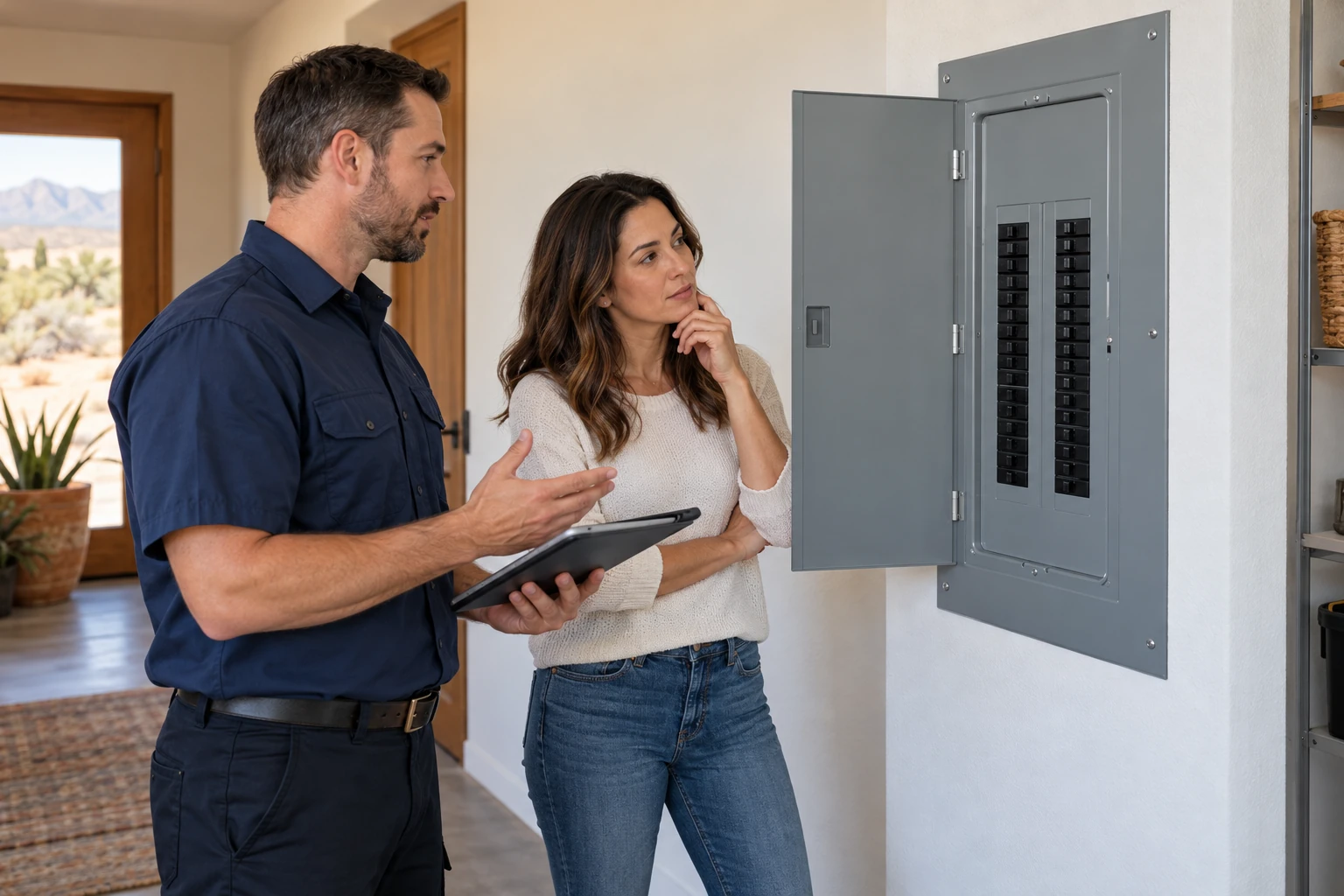
A panel replacement swaps an aging or damaged panel for a new one at the same amperage. This happens when the box itself is failing or unsafe, or from a manufacturer with a known reliability problem. The electrical service coming into the home stays the same.
A service upgrade increases the amount of power available to the house. That usually means moving from 60 or 100 amps up to 200 amps. This is the more involved job. It typically touches the meter socket and the service entrance conductors. Sometimes it touches the utility connection itself, not just the panel box.
Most homeowners searching for panel upgrade pricing are really asking about a service upgrade. That’s the focus of this guide. But if a contractor quotes your job, confirm which one they’re actually pricing. The gap between the two is significant.
There’s a third version worth mentioning: adding a subpanel instead of replacing the main panel. This works when the main service already has enough capacity. A specific area of the home, like a converted garage, a workshop, or a casita, needs its own dedicated circuits. A subpanel avoids running everything back to the main box. It’s a smaller job than a full service upgrade. For a targeted addition, it’s often the more cost-effective route.
2026 New Mexico Cost Breakdown by Scenario
These figures reflect labor, materials, and typical permit costs for residential work in the Albuquerque metro area as of 2026. Rural areas served by cooperatives instead of PNM can run higher due to travel time and different utility coordination requirements.
Straightforward 100-amp to 200-amp upgrade, panel stays in place: Roughly $1,800 to $3,200. This assumes the existing wiring, panel location, and service entrance can support the larger equipment without major rework.
60-amp fuse box or an unsafe panel brand (Federal Pacific, Zinsco, older Challenger equipment) replaced with 200-amp service: Roughly $3,200 to $6,000. These jobs almost always involve full rewiring of the service entrance and sometimes grounding upgrades that a modern code cycle requires but a 1960s installation never had.
Panel relocation (moving the box out of a bathroom, closet, or another non-compliant location to a garage or exterior wall) adds $800 to $2,500 on top of the base upgrade cost, since every circuit in the house has to be extended to the new spot.
Subpanel addition for a workshop, casita, or detached garage: $900 to $2,200, depending on trench length if the subpanel is in a separate structure.
400-amp service, typically for larger homes running EV chargers, solar, and heavy HVAC simultaneously: $4,500 and up, largely because it usually requires new utility-side infrastructure rather than just homeowner-side equipment.
Permit fees in Albuquerque are calculated against declared project value and generally land between $50 and a few hundred dollars for a standard residential electrical permit. Most licensed contractors fold this into the quoted total rather than billing it separately.
A standard panel swap or upgrade typically runs four to eight hours of active work, with the home losing power for part of that window while the old panel comes out and the new one is connected. Jobs involving a meter relocation or a full rewire of the service entrance often stretch across two working days, particularly if PNM needs to schedule a separate visit to disconnect and reconnect service at the transformer or meter base.
What Actually Moves the Number
Panel age and brand. A working panel from a reputable manufacturer sometimes just needs more breaker capacity. A panel with double-tapped breakers, scorch marks, or a recalled brand needs to come out entirely. That adds labor and disposal cost.
Whether the meter socket is rated for the new amperage. A 100-amp-rated meter base can’t carry 200 amps safely. If it needs replacing, that gets coordinated with PNM. It adds both cost and a short window where the home is without power.
Wire gauge and conduit condition. Aluminum branch wiring or undersized conductors from an earlier era sometimes need upgrading alongside the panel. That’s a different scope than the panel swap itself.
Grounding and bonding. Older Albuquerque homes frequently predate modern grounding electrode requirements. Adding a proper ground rod or bonding to a metal water line is inexpensive on its own. It’s also easy to miss in a lowball quote.
Access and site conditions. A panel in an easily reached garage costs less to work on than one buried behind finished drywall or in a cramped mechanical closet.
Concurrent projects. If the upgrade happens alongside a kitchen remodel, a room addition, or an EV charger install, bundling the electrical scope into one mobilization often costs less overall than scheduling separate visits. Anyone planning a larger renovation should loop electrical capacity into that conversation early. Don’t treat it as an afterthought once the panel is already maxed out.
Permitting: What Albuquerque and New Mexico Require
New Mexico’s electrical code is built on the National Electrical Code. It’s adopted statewide and administered by the Construction Industries Division’s Electrical Bureau. Home-rule cities like Albuquerque enforce it through their own building safety office. Practically, that means a panel upgrade in Albuquerque is a state-code job with a local permit sitting on top of it.
A permit from the City of Albuquerque Building Safety Division is required before work starts, not after the fact. Swapping a light fixture or an outlet in its existing location is exempt. Panel work, new circuits, and service upgrades are not. Albuquerque does allow homeowners to pull their own electrical permit if they pass a written exam through the city. In practice, most people doing a full panel upgrade hire a licensed contractor and let the contractor handle the permit and inspection scheduling.
Inspections happen at defined points in the work. There’s typically a rough-in check before walls close up, if applicable, and a final inspection once the panel is energized. Skipping this step to save time is a common shortcut. It causes real problems later, particularly at resale, when a home inspector or appraiser flags unpermitted electrical work and the sale stalls until it’s corrected.
Where PNM Fits Into the Process
For most PNM customers, any service upgrade requires a service application submitted to the utility before work begins. This applies even when it isn’t a panel swap at the same amperage. PNM reviews the request and confirms the existing service drop and transformer can support the new load. Then PNM coordinates the meter change with the contractor’s schedule.
Full details on the application process are on PNM’s service upgrade page.
This step is often where timelines slip. A straightforward upgrade with adequate existing infrastructure can move quickly. A home where PNM determines the transformer or service line needs work takes longer. In rarer cases, it involves cost-sharing between the customer and the utility for the infrastructure work. Anyone on a tight timeline, like closing on a home sale or finishing a remodel before a deadline, should ask their contractor to confirm PNM’s expected turnaround before locking in a completion date.
Why More New Mexico Homeowners Are Upgrading Now
Load demand on residential panels has climbed steadily. More homes are adding EV chargers, heat pumps, and battery storage on top of the appliances a 1990s-era 100-amp panel was originally sized for. A Level 2 EV charger alone can draw 30 to 50 amps continuously. That’s enough to push an older panel past its safe capacity once it’s added to an existing load of central AC, an electric range, and a dryer.
Solar adoption follows a similar pattern. New Mexico’s high sun exposure makes rooftop solar a popular addition. But PNM’s interconnection process requires the home’s electrical service to meet current standards before a system gets approved and connected. A panel that’s outdated or undersized often becomes the first item on the punch list, ahead of the solar installation itself.
Smart panels pair standard breaker capacity with circuit-level monitoring and load management software. They’ve gained traction with homeowners who want to add an EV charger or solar without paying for a full service upgrade to 400 amps. They cost more upfront than a standard panel. But they can make a 200-amp service handle demands that would otherwise require a larger, more expensive utility connection. Whether that trade-off makes sense depends on the specific mix of appliances and future plans for the home. It’s worth walking through with an electrician before committing either way.
Signs the Upgrade Shouldn’t Wait
A panel that trips repeatedly under normal use is telling you something. This is different from tripping only when running a space heater and a hair dryer at once. Lights that dim noticeably when the AC compressor kicks on point to the same issue. A fuse box instead of a breaker panel, double-tapped breakers, or a panel branded Federal Pacific or Zinsco are worth acting on regardless of whether anything has failed yet. These are known reliability risks, not hypothetical ones.
Adding an EV charger, a home office with server equipment, or a casita as part of a home addition is also a natural trigger point. It’s far cheaper to size the panel correctly once. Upgrading twice within a few years, because the first job didn’t account for what came next, costs more in the long run.
Choosing Who Does the Work
Verify the electrician’s New Mexico license directly. Don’t just take a business card at face value. The state’s Construction Industries Division maintains license lookup tools for exactly this reason. Confirm the contractor is pulling the permit in their name. Don’t let them ask you to pull it as the homeowner while they do the work. That shifts liability onto you if something goes wrong.
A detailed quote should separate the panel, the labor, the permit, and any anticipated utility coordination. It shouldn’t arrive as one lump number. That level of detail is usually a decent proxy for how carefully the actual work will be done.
Ask directly whether the price includes bringing grounding, bonding, and AFCI or GFCI protection up to current code. These items get left out of lowball bids. They show up later as change orders once the inspector flags them. Also ask what brand of panel is being installed. Confirm it isn’t a budget import with a thin warranty. A panel isn’t a place to save a few hundred dollars on equipment that’s supposed to protect the rest of the house for the next 30 years.
It’s also worth asking how the contractor handles the inspection itself. A licensed electrician familiar with Albuquerque’s Building Safety Division should be able to explain the rough-in and final inspection process plainly. They should know roughly how long each step takes to schedule. Vague answers here are usually a sign the contractor hasn’t done many permitted panel upgrades in the city, regardless of how the rest of the pitch sounds.
Happy Homes LLP handles panel upgrades as part of its broader electrical services New Mexico, working across Albuquerque and surrounding communities. The team coordinates permitting and inspections alongside any remodeling or addition work happening at the same time. A home’s electrical capacity is easy to ignore until it becomes the reason a renovation stalls. Getting an accurate read on your panel before that happens is the more useful order of operations.