General Contractors License Gb98 #416168

Insured And Bonded

Blog

Day: October 30, 2026

how-long-does-stucco-last-new-mexico
Uncategorized

How Long Does Stucco Last in New Mexico?

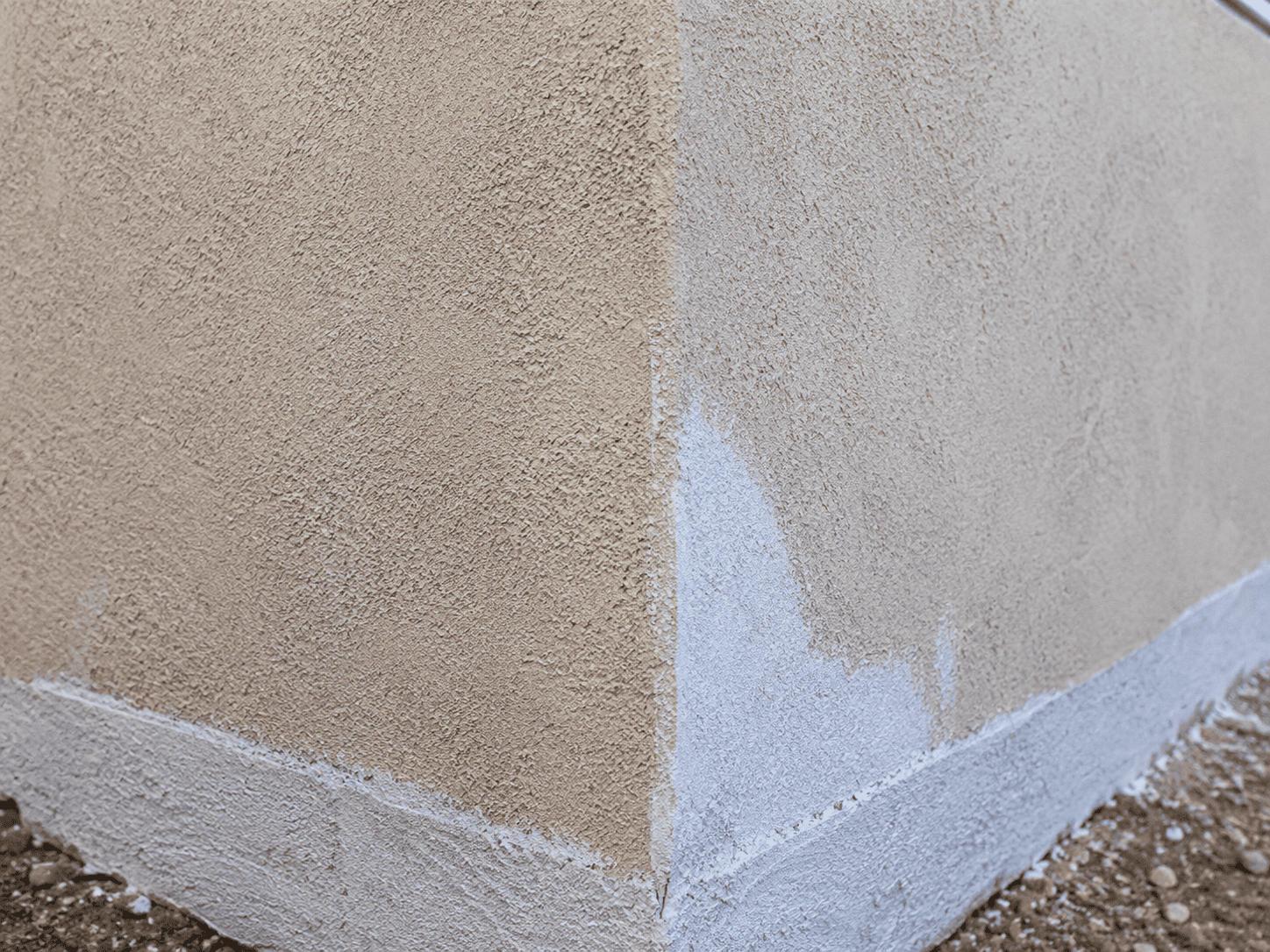
Lifespan, Warning Signs & Replacement Timeline Quick answer: A properly installed traditional three-coat stucco system in New Mexico typically lasts 50 to 80 years structurally, though the visible finish coat needs attention every 15 to 25 years. EIFS (synthetic stucco) systems have a shorter practical lifespan, often 20 to 30 years, because moisture problems tend to surface earlier. The number that matters most for your specific wall isn’t the material’s theoretical maximum. It’s how the original installation handled moisture, and how the last owner maintained it. Most articles answer this question with a single number, as if every stucco wall in Albuquerque, Santa Fe, and Las Cruces ages on the same clock. It doesn’t. A wall installed correctly over a proper weather-resistive barrier, with a weep screed sitting where code requires it, behaves nothing like a wall where a previous contractor skipped the control joints to save a day of labor. This guide breaks lifespan down by system type, walks through what actually determines whether your stucco hits year 20 or year 60, and gives you a decade-by-decade picture of what aging stucco looks like in New Mexico so you can tell the difference between a cosmetic issue and a wall that’s telling you something serious. Lifespan by Stucco System Type New Mexico homes are clad in a handful of distinct stucco systems, and confusing one for another is the single most common reason homeowners get bad advice. Checking permit history or asking a contractor to assess the actual base coat condition gives a far more accurate age estimate than simply going by your home’s build year, since many New Mexico properties have had partial or full restucco work done at some point along the way. Traditional three-coat cement stucco (scratch coat, brown coat, finish coat over metal lath) is the system most common on older New Mexico homes and remains the standard for new construction and restucco work across the state. When it’s installed to ASTM C926 and ASTM C1063 specifications, this system is designed to last 50 to 80 years at the structural level. The finish coat on top, which is what you actually see and touch, has a much shorter practical life: typically 15 to 25 years before chalking, fading, and hairline cracking call for a fresh coat. One-coat stucco systems, common in production-built New Mexico neighborhoods from the 1990s and 2000s, use a polymer-modified base coat over foam or fiberglass mesh reinforcement in place of the traditional three layers. These systems can perform well, but they’re less forgiving of installation shortcuts, and their practical lifespan tends to run 30 to 50 years before major intervention is needed. EIFS (Exterior Insulation and Finish Systems), the synthetic foam-core stucco found on a meaningful share of Rio Rancho homes built between the mid-1980s and mid-2000s, is where lifespan expectations diverge the most. A correctly flashed and drained EIFS wall can last 30 years or more. An EIFS wall with a history of poor window flashing, which was unfortunately common during that construction era, can develop hidden moisture damage inside the foam core within 10 to 15 years, long before the exterior shows anything alarming. What Actually Determines How Long Your Stucco Lasts The material itself is rarely the limiting factor. Four things do most of the work in deciding whether a wall reaches its full lifespan or fails early. Installation quality against the standard. ASTM C926 governs the plaster mix, coat thickness, and cure times; ASTM C1063 governs how the lath is fastened and lapped. Walls that skip the required 48-hour cure between coats, or that use undersized lath fastening spacing, develop weak points that show up as premature cracking years before a code-compliant wall would. Weep screed placement. Every framed stucco wall needs a weep screed at the base, set with proper clearance above grade, that gives moisture a way out of the wall cavity. The Stucco Manufacturers Association guide specification calls for this clearance because stucco is not a waterproof membrane. It’s a reservoir cladding system that absorbs and releases moisture over time, and the actual water barrier is the weather-resistive layer behind it, not the visible finish. A buried or improperly flashed weep screed traps water at the wall base and accelerates rot and lath corrosion from the bottom up. Control joint spacing. Stucco expands and contracts with New Mexico’s wide daily temperature swings. Control joints give that movement somewhere to go. Walls without enough joints, or with joints placed incorrectly, develop stress cracks in predictable patterns that widen every season. Substrate and moisture management. The weather-resistive barrier required under the International Residential Code is what actually keeps bulk water out of the wall assembly. Stucco’s job is to shed most of the water and manage the rest; the barrier behind it handles what gets through. When that barrier is missing, damaged, or improperly lapped at penetrations, the stucco above it can look fine on the surface while the wall assembly underneath is already failing. New Mexico’s Climate: Accelerant, Not Cause New Mexico’s stucco doesn’t fail because of the climate alone. It fails when a wall with one of the four vulnerabilities above meets New Mexico’s specific stress patterns. Statewide, two forces do most of the damage. The first is thermal cycling: large daily temperature swings between intense daytime sun and cool desert nights open and close hairline cracks year-round, a stress pattern that’s especially pronounced around stucco repair Albuquerque properties given the metro’s elevation and exposure. The second is moisture timing: New Mexico gets relatively little annual precipitation, per NOAA climate normals, but what does fall tends to arrive concentrated in short, intense monsoon bursts or, at higher elevations, as freeze-thaw cycles through winter. Concentrated moisture events punish existing cracks and weak flashing far more than the same total rainfall spread evenly across the year would. That combination is why a stucco wall’s condition in Santa Fe, Taos, Rio Rancho, or Las Cruces can look so different at the same age, even with identical
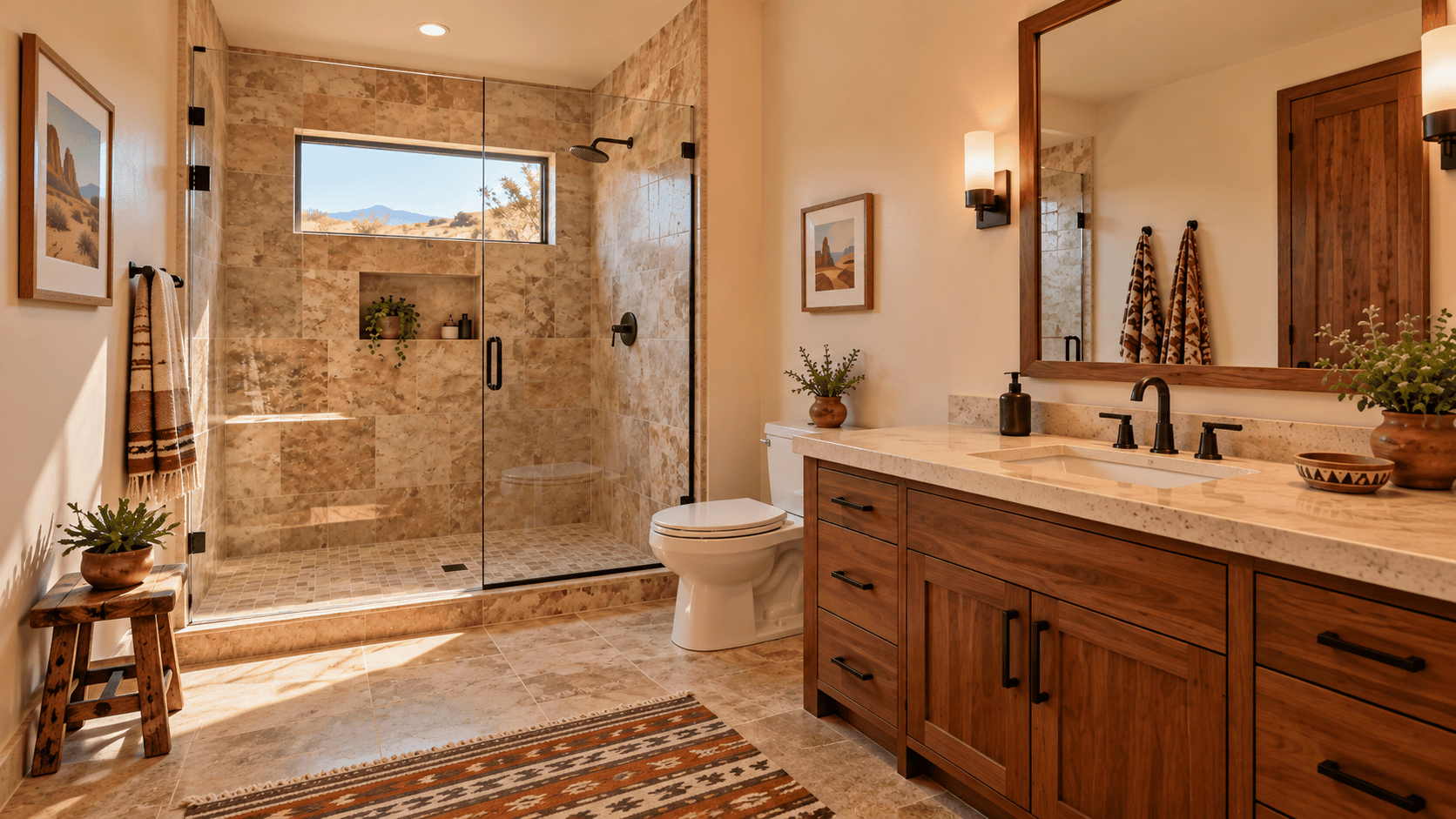
Modern bathroom with a glass-enclosed shower, stone tiles, and wooden vanity, illustrating the cost to add a bathroom in New Mexico.
Uncategorized

Cost to Add a Bathroom in New Mexico: What Drives the Price and What to Expect

Ask a plumber to price a new bathroom and he spends the first ten minutes of the visit ignoring the room you had in mind. He goes out to the yard to find the sewer cleanout, comes back in, and starts tapping walls to work out which ones already carry pipe. By the time he sits down, he already knows whether your project is a simple tie-in or a floor-cutting job. Tile and vanities come up much later in that conversation, and they move the final number far less than most people expect. Here is what actually drives the cost to add a bathroom in New Mexico, so a bid stops reading like one big number and starts reading like a list of decisions you can question. What people are paying right now Nobody can quote your house from a webpage. What the current national data gives you is a set of ranges honest enough to plan around. Take space you already own, say a deep hall closet, a laundry room, or a slice off an oversized bedroom, and the work usually lands somewhere between $8,000 and $25,000. Build a new room onto the outside of the house for the same bathroom and you are looking at $25,000 to $75,000, because a foundation, walls, and a roof all have to exist before a toilet can be set. Split by bathroom type, half baths run roughly $5,000 to $15,000. Three-quarter baths, which drop the tub and keep the shower, sit around $6,000 to $25,000. Full baths run $15,000 to $50,000. Primary suite bathrooms regularly pass $75,000. Those figures come from national datasets that mix expensive coastal markets in with cheap ones, so read them as a frame rather than a quote. New Mexico trade labor generally sits under the national average, with Santa Fe as the usual exception. And no national average knows anything about your slab, your existing drain runs, or how full your breaker panel is. Everything comes back to the drain Getting water to a bathroom is easy. Supply lines are half-inch and three-quarter-inch, they bend, and a good plumber can snake them almost anywhere. Waste is the problem. A toilet needs a three-inch drain, and that drain has to fall toward the main at a steady slope the code sets. It will not bend around a beam or hop over a duct. It needs a clear, downhill path from the toilet flange to the line that already leaves your house. Put the new bathroom back to back with an existing one and the plumber ties into a stack that is sitting right there. Push it thirty feet across the house and somebody is opening floors, cutting joists, or trenching concrete to build a path that never existed. That decision on its own can move a bid by several thousand dollars, and it is settled before anyone talks about finishes. It is also why a contractor who knows the work asks where your main line runs before asking what tile you like. Our plumbing services crew maps that route on the first visit, because the answer often changes the floor plan. Slab houses and the concrete question Outside the older adobe pockets, most New Mexico homes sit on a slab. No crawlspace, no basement, nowhere to hide pipe. The drains are under the concrete or cast into it. So a bathroom in a spot with no drain nearby means the floor gets cut. Saw-cut the trench, break out the concrete, hand-dig underneath, lay the pipe at the right fall, hold everything open for the inspector, then backfill, compact, and pour it back. Add dust containment, because this is demolition happening inside a house somebody is living in. There is nothing exotic in any of that. It is just slow, and slow is what costs money. Older Albuquerque neighborhoods bring a second thing to watch. Cast iron waste lines from the fifties and sixties can be partly eaten through. If the slab comes open and the main will not take a new connection safely, replacing that run becomes part of your project whether you planned for it or not. Half baths do not cost half A half bath gets a toilet and a sink. A full bath adds a tub or shower. On paper that reads like fifty percent of the price. The math falls apart because nearly every fixed cost applies to both of them. Same three-inch toilet drain. Same supply lines, same vent, same GFCI circuit, same light, same door, framing, drywall, flooring, permit, rough-in inspection, final inspection. What the full bath piles on top is the shower or tub, a two-inch drain for it, waterproofing, tile, and more floor area. Real money, sitting on a base you were paying for anyway. In practice a half bath tends to land 40 to 50 percent below a comparable full bath. If your house genuinely needs a second shower, the gap is usually worth closing. If the real problem is one toilet and four people, a powder room solves it for much less. Borrowing space you already have Working inside the existing footprint is almost always cheaper, and the savings sit in the structure rather than the finishes. A conversion skips excavation, footings, foundation, exterior walls, stucco, roof framing, and the roof tie-in. Those are the heavy items on any addition. Plumbing, venting, wiring, ventilation, and finish work all still happen in full, which catches people out. They expect a conversion to feel like a small remodel, and it rarely does. The candidates we see most in New Mexico homes are an oversized hall closet, a laundry room with a few feet to spare, a corner taken off a large primary bedroom, and part of an attached garage. Garages carry their own conditions. The floor slopes toward the door and has to be leveled. The space needs insulation and heat. Often the cheapest route is a raised floor so drain lines run above the slab instead of through

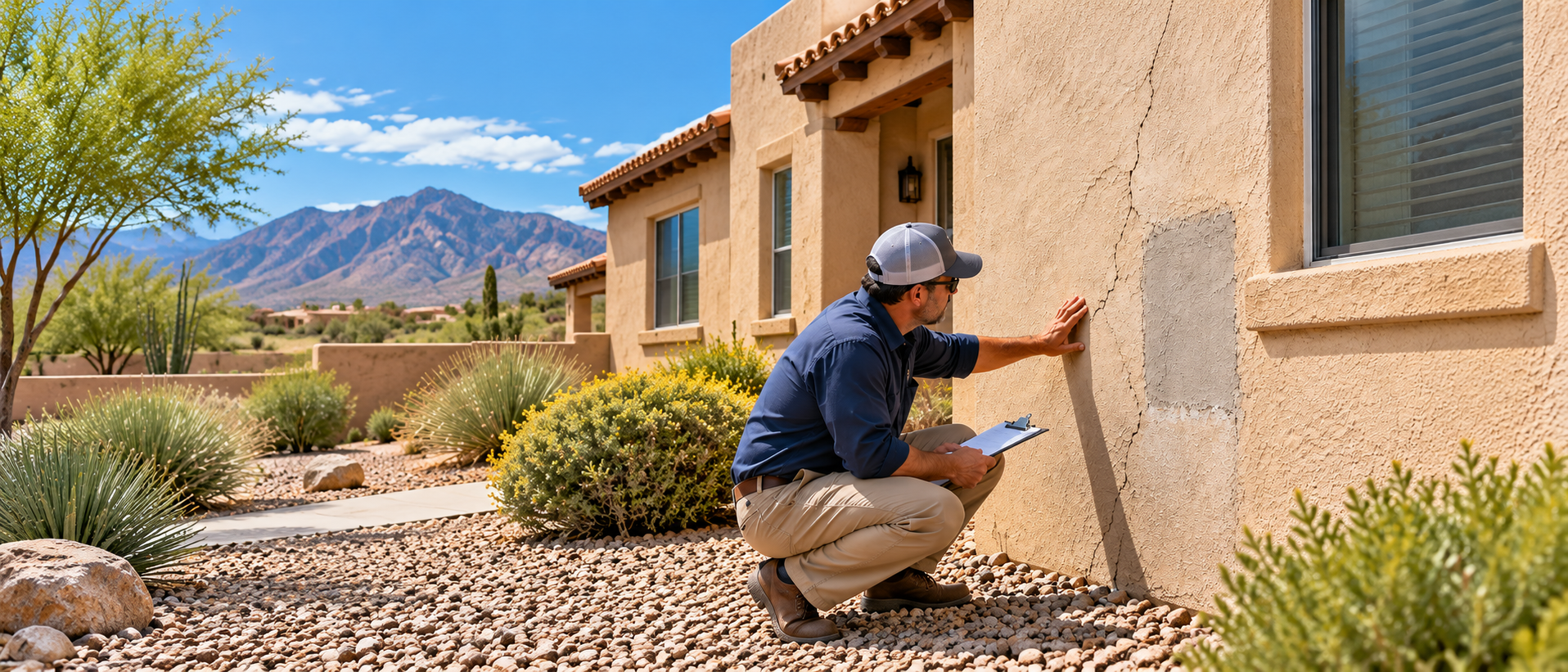
Contractor inspecting cracked stucco and a repair patch on a New Mexico home to assess stucco repair cost in New Mexico.
Uncategorized

Stucco Repair Cost in New Mexico: What Homeowners Actually Pay in 2026

Stucco is the defining exterior finish across New Mexico. It shows up on Pueblo Revival homes in Santa Fe. It covers Territorial-style houses in Albuquerque. It shapes adobe-inspired builds in Taos, and it wraps newer subdivisions in Rio Rancho and Las Cruces. The high desert climate is part of why stucco works so well here. But that same climate is also what wears it down. Intense sun, wide temperature swings, and, depending on where you live, either monsoon downpours or hard winter freezes all take a toll over time. Knowing what stucco repair actually costs in New Mexico helps you budget accurately. It also helps you recognize a fair quote when you see one, and spot an inflated one just as fast. This guide breaks down real 2026 pricing by repair type, by region, and by what pushes the number up or down. For an overview of the work itself, our statewide stucco repair services page covers the systems and methods we use. Pricing on its own only tells part of the story, though. A 1970s adobe-style stucco system in Taos fails differently than a 2005 EIFS system in Rio Rancho. Lath and plaster is the trade stucco actually evolved from, and a contractor who understands it catches those differences early. That saves you from an expensive surprise mid-project. Average Stucco Repair Cost in New Mexico Most stucco repair projects in New Mexico fall between $350 and $6,000. That’s a wide range. A hairline crack on one wall and a wall section with deep water damage are two completely different jobs, and the price reflects that difference. A small patch repair typically runs $350 to $800. A repair involving moisture damage or widespread cracking can climb to $2,000 to $6,000. Full resurfacing of an entire home’s exterior sits in its own category, running $5.00 to $7.50 per square foot, or roughly $7,500 to $18,000 for an average-sized home. A full tear-down to the substrate costs more. See our stucco resurfacing vs. full replacement guide for that breakdown. Repair Type Typical Cost Range Hairline crack repair $150 to $450 Structural crack repair $400 to $1,800 Small patch repair (under 10 sq ft) $350 to $800 Medium patch repair (10 to 50 sq ft) $800 to $2,800 Water damage repair $1,000 to $6,000+ Full resurfacing (per home) $7,500 to $18,000 These figures line up with current national data. Angi, Thumbtack, and HomeGuide all put stucco repair nationally between $8 and $50 per square foot, with typical projects landing between roughly $600 and $4,900. New Mexico’s numbers sit toward the lower-to-middle end of that national band for straightforward repairs. Labor rates here run below coastal and high-cost metro markets, which helps keep routine work affordable. Once water damage or substrate replacement enters the picture, though, New Mexico pricing climbs toward the upper end of the national range just like anywhere else. Stucco Repair Cost Per Square Foot Across New Mexico Per-square-foot pricing is the easiest way to compare quotes from different contractors. It strips project size out of the equation and gives you a clean number to compare. Across New Mexico, stucco repair generally costs $8 to $25 per square foot. Surface-level work sits at the low end of that range. Think hairline cracks or small chips that only need patching. Repairs that require cutting out damaged substrate, replacing wire lath, and matching a custom texture land toward the high end instead. Full resurfacing runs $5.00 to $7.50 per square foot in most of the state. Homes with severe substrate damage, or ones that need a full tear-down, move into replacement pricing, which costs considerably more. Labor typically accounts for at least half the total cost. Licensed stucco contractors in New Mexico currently charge $45 to $75 per hour, and that rate is one of the biggest swing factors in any final quote. How Stucco Repair Cost Varies by Region and Climate New Mexico’s climate isn’t uniform, and neither is the damage stucco takes on across the state. A contractor who only works in one region can easily misread what’s actually failing when they see it somewhere else. Albuquerque. The dominant issue here is thermal cracking. Daytime heat expands the stucco surface, and overnight cooling contracts it right back down. Years of that cycle create hairline and structural cracks over time. The monsoon season, which runs roughly July through September, turns any open crack into a fast-moving moisture problem. Albuquerque also sits at around 5,300 feet, so UV exposure is stronger than at lower elevations. That degrades finish coats faster than in milder climates. See our Albuquerque stucco repair services for city-specific detail. Santa Fe and Taos. At higher elevation, freeze-thaw cycling replaces monsoon damage as the primary driver. Water works its way into a crack, freezes, and expands, forcing the crack wider than it started. This process often reaches the substrate faster than thermal cracking alone would. Repairs in these areas tend to sit toward the upper half of the statewide range, since freeze-thaw damage more often calls for substrate and lath work rather than a simple surface patch. Learn more about stucco repair in Santa Fe and stucco repair in Taos. Las Cruces. Sustained, intense UV exposure in the southern part of the state accelerates delamination. That’s the process where the finish coat starts separating from the base coat underneath. It shows up as chalking, fading, and eventually peeling, rather than cracking outright. Repairs here usually involve more finish-coat work than crack repair, which shifts the cost mix even when the total lands in a similar range to other regions. Details on stucco repair in Las Cruces cover the local delamination pattern in more depth. Rio Rancho. A large share of the housing stock in Rio Rancho was built in the 1990s and 2000s using EIFS synthetic stucco systems. Those systems are now 20 to 30 years old in many neighborhoods, which puts them close to the end of a typical EIFS service life. Homeowners here are more likely to